When IT Stops Taking Orders and Starts Leading the Business
- Chris Bellew
- May 18
- 3 min read

Why the most effective technology organizations focus on people, process, and partnership—not just systems
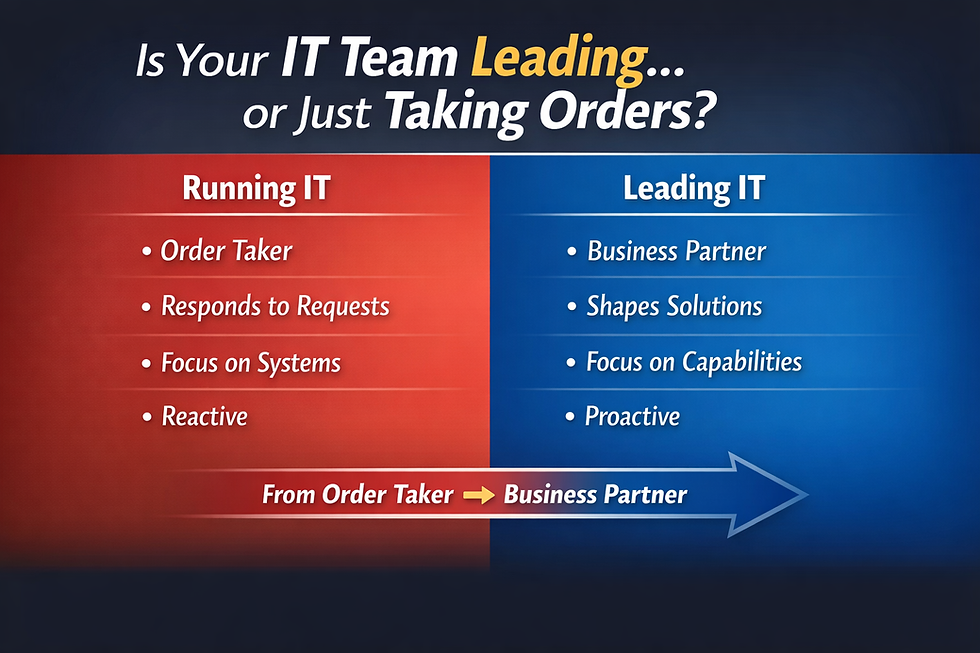
Many companies think they are leading IT. Most are just running it. Systems are stable. Tickets get resolved. Projects move forward. Operationally, things appear to be working. But technology isn’t truly advancing the business.
I worked with one organization where IT metrics looked excellent on paper—uptime was strong, support was responsive, projects were getting done. But when operational problems surfaced, nobody instinctively brought IT into the conversation. That told me IT was viewed as a support function, not a business partner.
In many environments, IT operates as an order-taking function. The business asks for a system, a report, or a new capability—and IT delivers. Running IT is about responding to requests. Leading IT is about partnering with the business to shape solutions and outcomes.
Another way to think about this shift is through the framework of people, process, and technology. Organizations that are running IT tend to focus heavily on the technology, while stronger organizations align people and processes first, with technology enabling those changes.
Some of the most technically capable IT teams I’ve seen still struggled to influence the business in a meaningful way. The difference usually comes down to how IT is positioned and led.
Here are a few distinctions that separate running IT from truly leading it.
Operational Management vs Strategic Leadership
Running IT is primarily operational—uptime, incidents, ticket queues, infrastructure, and project delivery. Those responsibilities are essential. But when leadership stays in operational mode, there is little room for strategic thinking.
Leading IT requires stepping back and asking:
How does technology enable the company’s growth strategy?
Where can technology improve efficiency or customer experience?
What capabilities will be needed three to five years from now?
Operational excellence keeps the lights on. Strategic leadership moves the business forward.
Technology as a Capability, Not Just a System
In many environments, IT is framed around systems and platforms. More mature organizations think in terms of capabilities. The conversation shifts from “What ERP do we run?” to “How well do we enable financial insight, supply chain visibility, or customer engagement?” That shift changes how investments are prioritized. The focus moves from tools to outcomes.
This is where people, process, and technology becomes critical. When IT is simply being run, the emphasis is often on systems and tools. When IT is being led, there is recognition that technology alone rarely solves business problems.
Technology projects usually fail for operational reasons long before they fail technically.
Clear Service Ownership
A common failure point is unclear ownership. In many organizations, responsibilities are fragmented across infrastructure, applications, and support. When issues arise, accountability becomes unclear.
More effective IT organizations define services and assign clear ownership. Service owners are accountable for performance, vendor coordination, lifecycle management, and continuous improvement—not just uptime. That clarity improves both accountability and alignment with the business.
True Business Partnership
The clearest difference is the relationship with the business.
When IT is primarily running operations, it behaves like a service desk—responding to requests and delivering what is asked for. This creates an order-taking dynamic, where the business defines both the problem and the solution.
Leading IT looks very different.
Technology leaders work alongside the business to understand challenges, identify opportunities, and shape solutions together. Instead of responding to requests, IT helps define the path forward. That shift—from order taker to business partner—is where real value is created.
Final Thoughts
Running IT well is essential. Stable systems are the foundation of every organization.
But the greatest advantage comes when IT moves beyond operations and becomes a true business partner. The shift from running IT to leading IT requires moving from order taking to partnership, and from focusing primarily on technology to shaping the people and processes that technology supports. When that happens, IT is no longer just a support function—it becomes a driver of the business.


Comments