Growth Rewards Speed. Scale Requires Structure.
- Chris Bellew
- May 18
- 3 min read


Most operational debt is created by good teams doing exactly what the business asked them to do.
And in high-growth organizations, that approach often works incredibly well — until the company reaches the point where speed alone is no longer enough. That’s when leadership discovers the organization has accumulated something far more difficult than technical debt: operational debt.
Technology debt is usually discussed in technical terms.- Outdated infrastructure. Legacy applications. Unsupported operating systems. Those things matter, but I’ve found the bigger risk inside many organizations is operational debt.
Operational debt builds slowly over time:
Processes are overly reliant on one person to execute
Vendor relationships without clear ownership or understanding of the relationship
Workarounds that become standard
Systems integrated through exceptions and tribal knowledge but no documentation
No clear accountability
What makes this challenging is that operational debt is often created during periods of high growth and success resulting in companies solving immediate problems such as opening the next location, scaling operations or onboarding and supporting new customers.
The priority, understandably, becomes speed and execution. Standardization, governance, and documentation for new processes and systems get pushed to “later.” The challenge is created when “later” never comes.
I recently worked with a fast-growing organization that expanded from a single location into multiple states in just a few years. What stood out was how talented and responsive the team was. They did exceptionally well at solving problems quickly and supporting the needs of the business as growth accelerated. New locations opened fast, operational issues were addressed quickly, and the business continued to scale successfully.
Like many high-growth organizations, the focus was naturally on execution and momentum. When a new challenge appeared, the team solved it and moved to the next priority. But over time, some of the foundational operational disciplines struggled to keep pace with the growth.
As leadership began assessing what would be required to support the company’s next stage of growth — including evaluating business applications, technology vendors, operational dependencies, and scalability — it became clear that some foundational information was difficult to pull together quickly.
There wasn’t always a clear understanding of:
where vendor agreements were stored
which contracts were current
which applications supported critical business functions
who owned key vendor relationships
or where accountability existed for renewals, oversight, and long-term planning
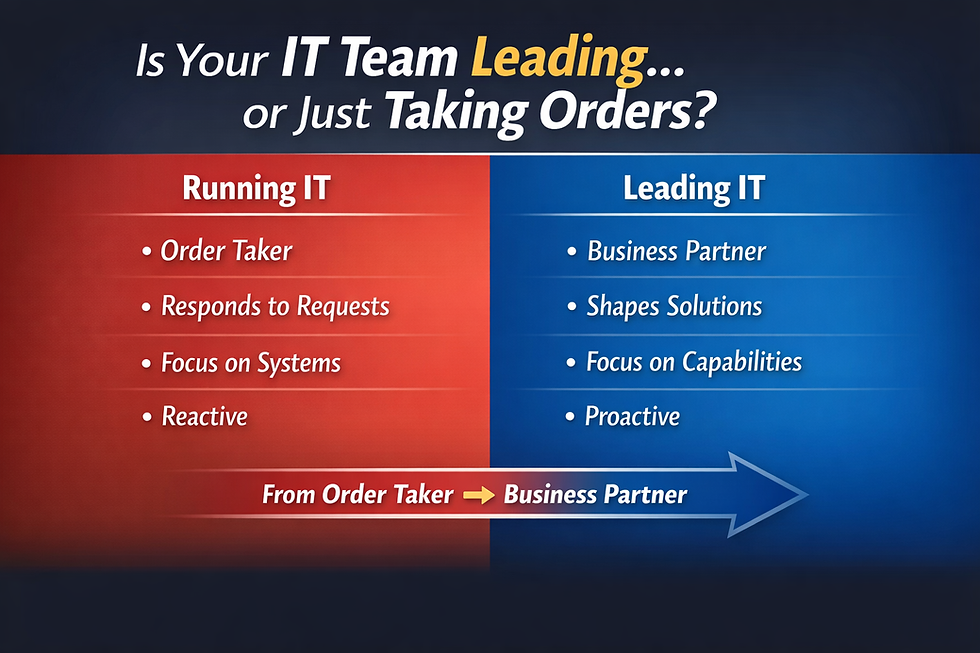
That wasn’t the result of poor performance. In many ways, it was the opposite. The team had become very effective at reacting to immediate business needs and delivering results quickly. But tactical execution naturally focuses down and in — solving today’s operational challenge, supporting the next opening, addressing the next issue impacting the business.
Strategic leadership requires looking up and out — preparing for the next stage of growth, the next transformation, or the next challenge before it arrives. In other words, creating time to think beyond the immediate issue.
If organizations never create the time to address operational debt, eventually the very systems and processes that once enabled growth to begin to slow it down. What was once agile becomes reactive as time to plan is reduced. Processes that once supported scale begin slowing it down. In other words, strategic leadership requires creating time to think beyond the immediate issue.
The real risk usually doesn’t appear during normal operations. It surfaces during periods of change such as acquisitions, divestitures, leadership transitions or infrastructure modernization. That’s when organizations discover how much of the environment depends on undocumented processes and institutional knowledge.
I’ve seen organizations with modern infrastructure and strong cybersecurity tools still struggle because operational discipline didn’t mature alongside the technology. The organizations that handle transformation well usually aren’t the ones with the newest technology. They are the ones with clear ownership, governance, strong processes and strong business alignment.
New technology without maturing operations moves existing challenges into newer environments.
Before asking whether systems are current, leadership teams should also ask:
Do we actually understand how the business works?
Can the organization operate effectively during transition or disruption?
Are vendors supplementing the organization or functioning as the organization?
Operational debt rarely appears on a balance sheet, but it becomes very visible during transformation. And by then, it’s usually expensive.


Comments