From Helpdesk to Hospitality: Rethinking IT’s Role in the Customer Experience
- Chris Bellew
- May 18
- 3 min read


Most IT organizations believe they’re delivering good service. And in many cases, the business would agree. But that’s often because they’ve never experienced anything different. Not because systems aren’t running—but because the experience of working with IT was never designed to be anything more.
That gap—between performance and experience—is where IT either builds trust or erodes it. It’s also where IT can learn from the hospitality industry.
Before I moved into IT leadership, I spent nearly a decade in the hospitality industry.
One lesson from that time has stayed with me throughout my career:
Service isn’t defined by what you deliver. It’s defined by how it’s experienced.
That perspective has shaped how I think about and lead IT ever since. IT may not always interact directly with the end customer—but it is always part of the chain that serves them.
A senior executive I worked for used to say:
“If you don’t work directly with the customer, you support someone who does.”
That applies across every function.
In manufacturing, your customer is the next step in the production line
In back-office functions, your customer is the team relying on your output
In IT, your customer is every function working to deliver value to the end customer
IT is not a standalone function. It is embedded in a customer value chain—where every system we design, every issue we resolve, and every interaction we have ultimately impacts how the business serves its customers. Most organizations talk about customer experience at the front door. Few design it into the functions that actually deliver it.
This is where many IT organizations fall short. They define their role too narrowly—focused on tickets, systems, and SLAs—rather than understanding their responsibility across the full lifecycle of business enablement. At its best, IT operates across four dimensions:
Engage - Be present in the business. Understand challenges before they become tickets. Build relationships that create context—not just requirements.
Solve - Work alongside the business to design solutions. Balance speed, cost, and risk. Focus on outcomes, not just delivery.
Operate - Ensure solutions are reliable, secure, and scalable. Build confidence through consistency and discipline.
Experience - Deliver service in a way that is clear, proactive, and complete. Follow through beyond resolution. Make it easy for the business to move forward.
This is where the hospitality mindset becomes relevant. Hospitality isn’t about being nice—it’s about ownership, anticipation, and consistency. In hospitality, if I checked in a guest late at night and knew the kitchen was about to close, I wouldn’t just hand them a room key. I’d ask if they were hungry, share the menu, and call the kitchen to get their order in before it shut down. Not because it was required—but because missing that moment would impact their experience.
In IT, the same principle applies. When we see a maintenance window or an outage, it’s not just about timing—it’s about impact. Understanding who is affected, anticipating downstream consequences, and adjusting accordingly is what separates service from experience.
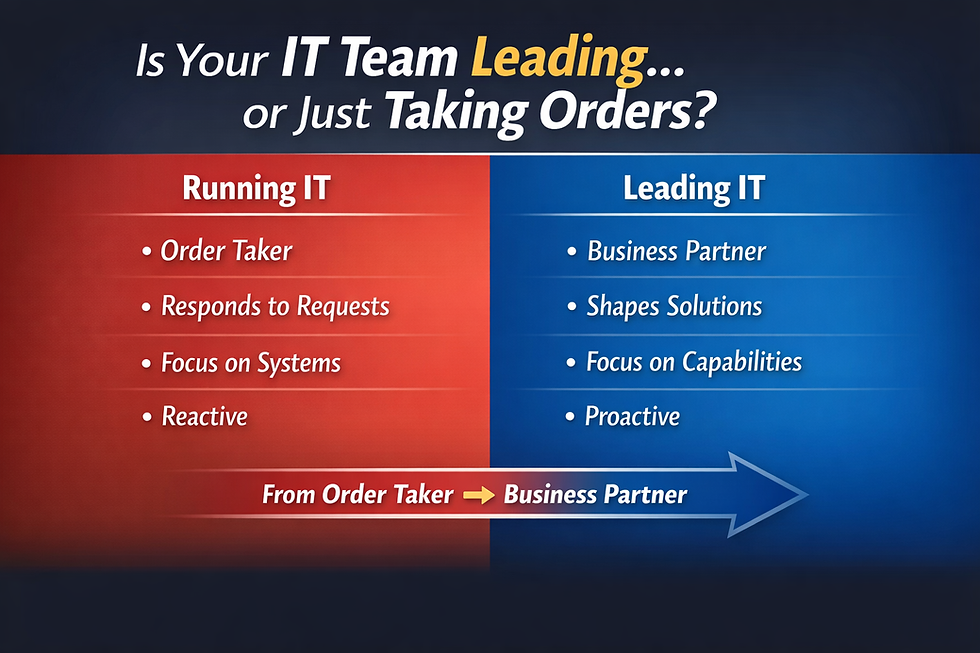
If you step back, there’s a clear progression in how IT organizations operate:
Reactive IT - Ticket-driven, focused on activity, limited engagement with the business.
Aligned IT - Partners with the business, delivers and operates solutions effectively, meets expectations.
Experience-Driven IT - Embedded in business priorities, understands its role in the customer chain, anticipates needs, and consistently delivers a high-quality experience.
That last stage is where real differentiation happens—
and where IT creates disproportionate value.
“Exceeding expectations” in IT rarely comes from big moments. It shows up in small, consistent behaviors:
Taking ownership without unnecessary handoffs
Communicating proactively—not just when asked
Understanding business impact—not just technical symptoms
Following up after resolution to ensure outcomes were achieved
Delivering a consistent experience across teams—not dependent on individual effort
And importantly—this doesn’t happen by accident. It requires structure:
Defined service standards
Clear accountability
Measurement beyond SLAs
At the executive level, IT is no longer judged solely on system availability.
It’s judged on:
The confidence it creates in the business
The speed at which the organization can execute
The experience it delivers to its internal customers
Because when IT struggles, friction shows up everywhere. And when IT performs at a high level, it becomes a multiplier for everything the business is trying to achieve.
At the end of the day, every function has a customer—IT included. The organizations that understand this—and operate accordingly—don’t just deliver better IT. They enable people.They support outcomes.And they help the business deliver a better experience to its customers-consistently. That’s the shift—from helpdesk to hospitality.
And it’s where IT creates its greatest value.


Comments